
Someone recently said of me, “You know that’s not normal, right?” What is normal? In this post, I’m going to be talking about what daily life looks like, what some of my mental health issues have been, and how I’ve come to deal with them. It is important to understand that what is “normal” for one person may not be so for another. What is considered normal is subjective based on factors such as life experience, beliefs, and the mental preferences that I talked about in part 1 of this series, “The Mind I Was Given“. Since normal is subjective in so many ways, it is also important to know that how we define it isn’t fixed; what we find to be normal today, we may feel differently about given time and further understanding. The most important take away from this entire mental health series is that we must keep moving forward. I hope that what I have to share here shows perseverance and determination; I hope that my will to survive and improve my situation, regardless of how small the wins sometimes are, can be seen through any “abnormal” behaviors. A win is a win, after all.
As always, please know that I have no medical or psychological training. I am just a person on the internet sharing their experience in hopes that someone will find my content relatable and helpful. If you are suffering with mental health issues, you should always seek professional help in addition to finding solace amongst those who’ve had to deal with similar circumstances.
It’s been a number of years since “The Day the Switch Flipped“, and anxiety and Obsessive Compulsive Disorder (OCD) started impacting my daily life. In my prior post, I talked a lot about what OCD is for me, but I didn’t mention how it feels. With contamination OCD you’re dealing with a fear of being contaminated and spreading contamination. This, obviously, involves your hands, but also your feet, and, really, any part of your body that comes into contact with potential contaminants. When I experience what I perceive as contamination, I have an immediate numbing of the physical body part that came into proximity of the contaminant. Note the use of the words “perceived” and “proximity”. I use these terms instead of words like know, think, and touched because I am typically concerned with the potential for contamination to have occurred rather than knowing it actually happened. In other words, with my eyes I see that I MAY have come into contact with a contaminant; a contamination event has begun; the body part in question goes numb.
Body parts going numb due to contamination OCD is a psychosomatic symptom. Psychosomatic refers to physical symptoms being induced by mental factors such as stress and anxiety. When coupled with distorted sensorimotor processing, which means your mind and body have difficulty interpreting sensory information from the environment, you can see how easily OCD can take an actual physical toll on you. It is exhausting. The more exhausted you are, the worse the symptoms become. In my case, when a contamination event has occurred, the body part in question will remain numb until I resolve the event through compulsive cleaning. This could mean washing my hands, or it could mean cleaning half of the apartment depending on the severity of the event. When I say the body part will remain numb until the compulsive cleaning has been done, I mean that I can sit through an entire movie laser focused on my hand, completely distracted from the film, unable to think about anything but the contamination and the potential for spreading it; this is only resolved through completing the cleaning.
Imagine taking off your shoes but being afraid to touch the rug your shoes sit on. No one can argue that the rug at their front door isn’t dirty from the outside world. While taking off your shoes, if your foot comes into contact or you perceive contact with the rug or the area immediately surrounding it, you will be forced into an evening of compulsive cleaning. You do not believe socks are capable of stopping contaminants from reaching your skin. Your skin will contaminate all flooring that it comes into contact with. Contaminating your flooring doesn’t mean the part you touched needs wiped off, it means the entire floor needs to be cleaned. Before you can start cleaning up from this contamination event, you have to shower to free yourself of the contaminants you encountered while outside of your home. Getting a shower is the only thing that will stop the psychosomatic symptom that is causing your foot to go numb; showering is also the only thing that will stop the contamination event from expanding. You have laminate floors, so that means scrubbing on your hands and knees, but, as you do so, you will go past doorways to various carpeted areas. The carpeted areas will now need to be vacuumed because of the potential for debris to have been spread onto them while cleaning the laminate; you can’t do this yourself because you were just cleaning the laminate and are now re-contaminated and in need of another shower. You ask your spouse to do the vacuuming while you take your second shower because your foot MAY have come into contact with the rug or the perimeter surrounding it. Your knees have scabs on them because this happens so often.
Instead of repeating this almost every time you come back to the house, you ask your spouse to watch you take your shoes off. They tell you, “No, you didn’t touch anything.” This, to me, is a coping mechanism. I am not facing my fear, I am avoiding it by having another person verify what my mind cannot currently verify on its own. My knees are also healed up. A small win for a person with a big problem, yes, but a win is a win.
As a person trying not to think about debris being sucked off of my rug and into my HVAC system to be blown around the house, I currently find it impossible to work on this issue through exposure therapy. Trying to push through events such as the one I just described has literally sent me into anxiety attacks. While I am all about a permanent and resolute solution to anxiety and OCD, I am also highly motivated to find fixes that allow me to function. As I’ve indicated, pushing through an event such as this causes an expansion of the problem; a problem that I am not currently equipped to deal with.
Coping mechanisms should not be frowned upon. I probably can’t fix myself in a day, a month… or even a few years. That doesn’t mean I’m not trying. Before I go any further, I need to touch on mental bandwidth. This topic will be the subject of my next post in this series, but I need to define it here. Mental bandwidth is the capacity with which we have to perform activities or to face mental challenges. There are a lot of things that eat away at our bandwidth which force us into making choices about what we can take on. For me, I have to rely on coping mechanisms as I am currently unable to fully eradicate anxiety and OCD from my life due to limited mental bandwidth. Coping mechanisms have allowed me to make progress in my life despite my limitations. Coping mechanisms have allowed me to have some semblance of “normalcy”.
At one time, I had to have my spouse watch me take laundry from the laundry room to the bedroom because I was so afraid of it being contaminated on the way from one room to another. Instead, I now follow lines in the laminate flooring that I have predetermined to safely keep me away from the walls, doors, etc. that I encounter along the path. I do the same thing when going into the den to watch TV or use my computer. If you research this behavior, walking lines, you’ll find that experts do not recommend this as it reinforces the OCD cycle. To this I’d say, prior to employing this coping mechanism, I would just sit in the corner a lot of days…
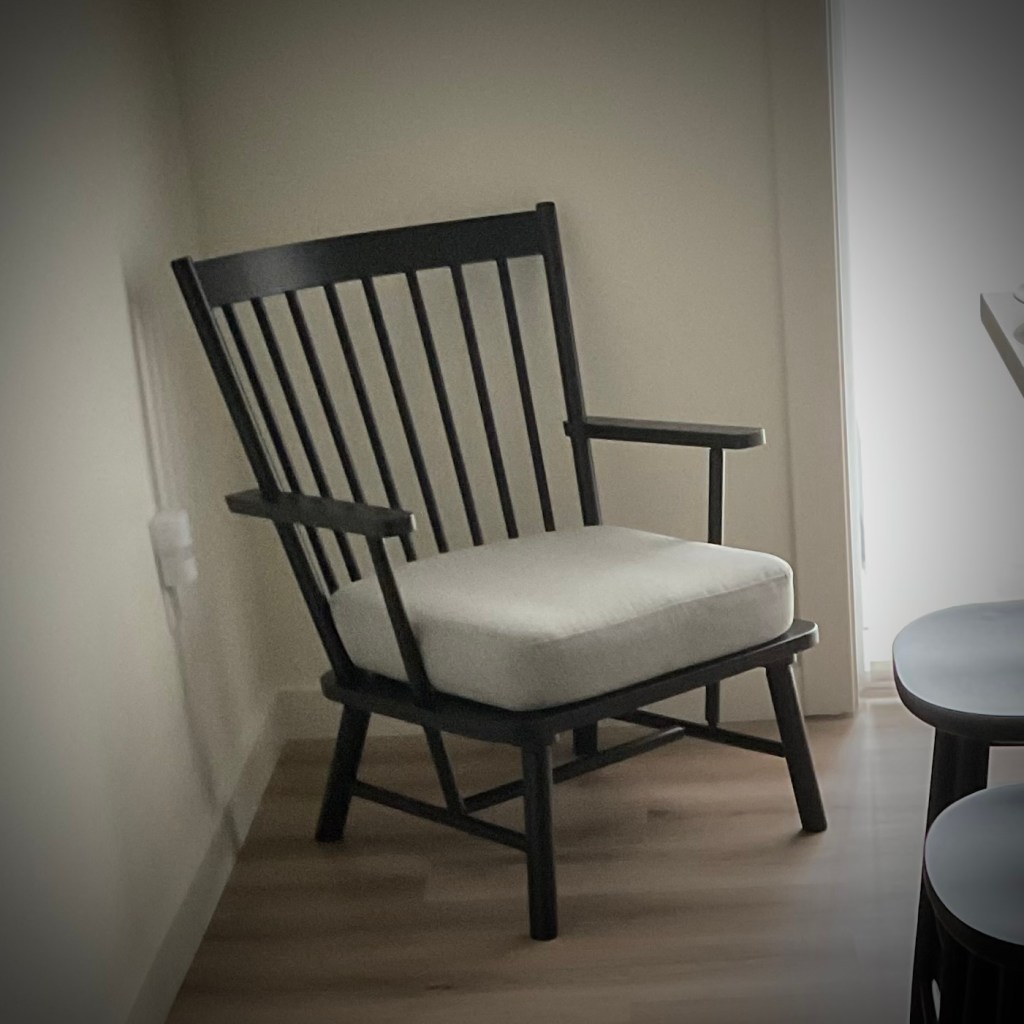
This chair, a coping mechanism itself, became a prison. I would wake up in the morning, do chores, make breakfast, but then I’d sit in my chair to read. I’d make lunch. I’d go back to my chair to watch something. Days became weeks, weeks became months. I wasn’t accomplishing anything I wanted to. I became paralyzed and afraid to move out of the kitchen and into other spaces from fears of contaminating them. There were clean areas of the house, and there were dirty areas. I had to stay in a dirty area. This is what they’re talking about when they say a coping mechanism can reinforce the OCD cycle. However, if you’re struggling to this extent, you can’t just flip the switch off and suddenly be ok to move about uninhibited. There has to be an in between that helps you to move forward.
The in-between space. This was my first attempt to get out of the chair. I bought a laptop and kept it at the kitchen island. This laptop gave me some activities that distracted my mind and gave me relief from OCD. A new coping mechanism that kept me in the kitchen, but out of the corner I had been punishing myself in. It wasn’t clean, but it wasn’t dirty either; it was an in-between space. After this, the living room became an in-between space. This meant I no longer needed to take a shower to sit down in the living room to watch a movie. I could make dinner, then sit down in the evening to watch something with Mary. The in-between space meant that other thought patterns and behaviors needed to change or could now evolve. Spaces that were off limits were opening up. The apartment was no longer divided into clean and dirty; long live the in-between. A win is a win.
For the better part of 2 1/2 years I had not been using what has now become the den in our home. I have been involved with music creation for nearly 30 years. A lot of those years have been spent in my personal recording spaces. For most of that time, I was not dealing with anxiety and OCD. Once OCD became an issue for me, I started losing the ability to comfortably work in my studio. For starters, the cables strewn about the room grated on me from a visual perspective, but once I started questioning anything that was on the floor, I quickly realized it was game over if I couldn’t resolve the matter. I fought this for a long time. By fight, I mean I kept the stuff, but I couldn’t use it. Each time I entered the space, it seemed that a contamination event occurred and out came the alcohol wipes and the accompanying endless cleaning. It became a waste. I started hating it. I couldn’t pick a cable up off the floor and plug it into a guitar. I couldn’t change guitar strings or perform basic maintenance. I couldn’t interact with wood that had open pores. I couldn’t interact with knobs.
I began paring the space down into what I thought I could handle. Guitar pedals were moved from the floor to the desktop. Guitar amps went away as I turned to digital emulations. My guitar collection was reduced to just a couple so that there would be less to manage. With each downsizing I felt relief, but I came to realize it was relief, not from OCD, but from the anxiety music creation had been putting on me; I came to understand a truth about OCD. OCD doesn’t exist in a vacuum for me. It is heavily influenced by mental bandwidth. The more I freed up bandwidth, the better I felt and the less I struggled with compulsions in the studio and around the rest of the apartment. Removing the items that caused compulsions helped in and of itself, but it was more than that; it was relief from the expectations I had been putting on myself. OCD stopped leading to anxiety attacks.
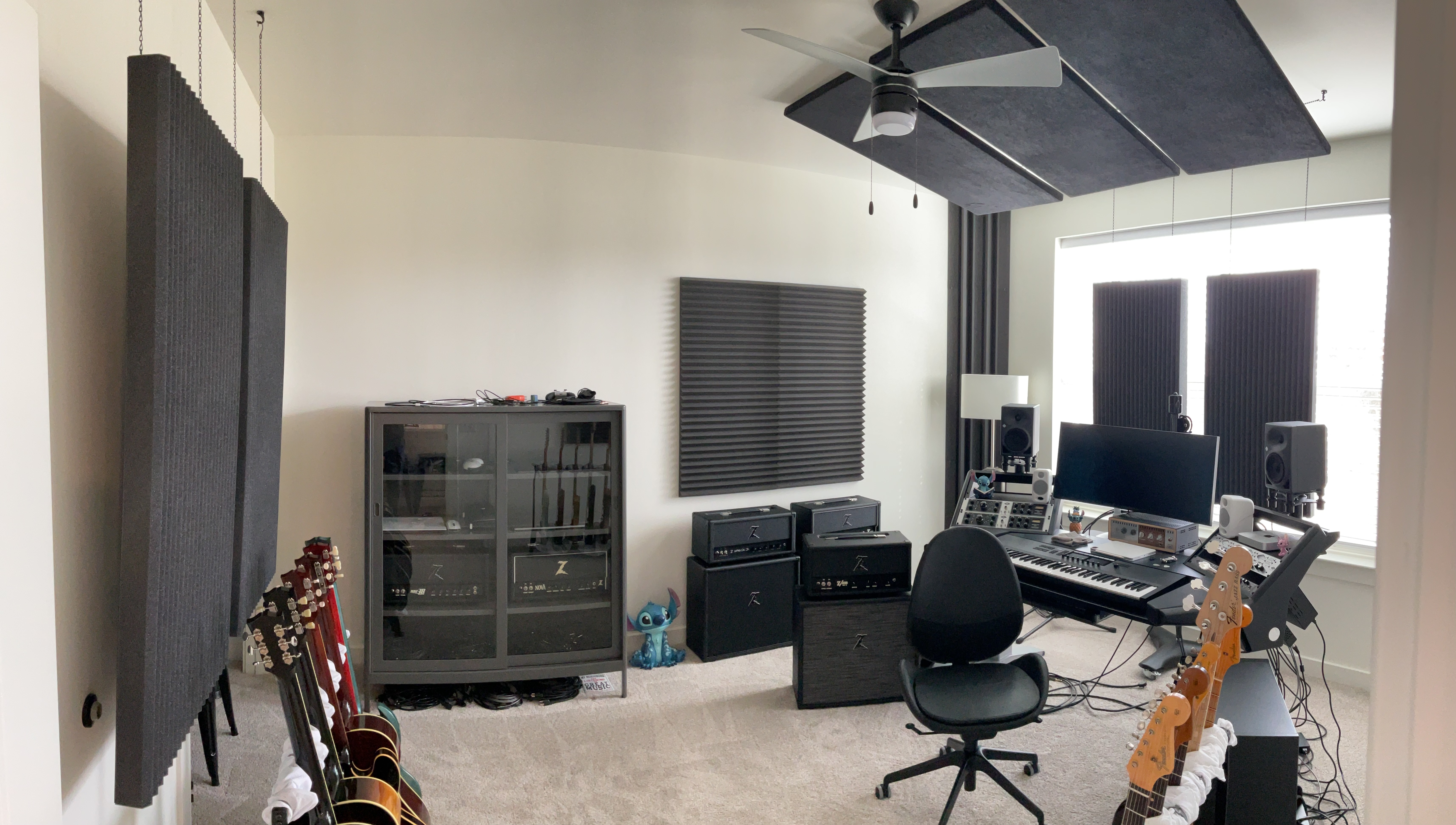
This became completely overwhelming. I had access to anything I had ever wanted musically, but I couldn’t use it… 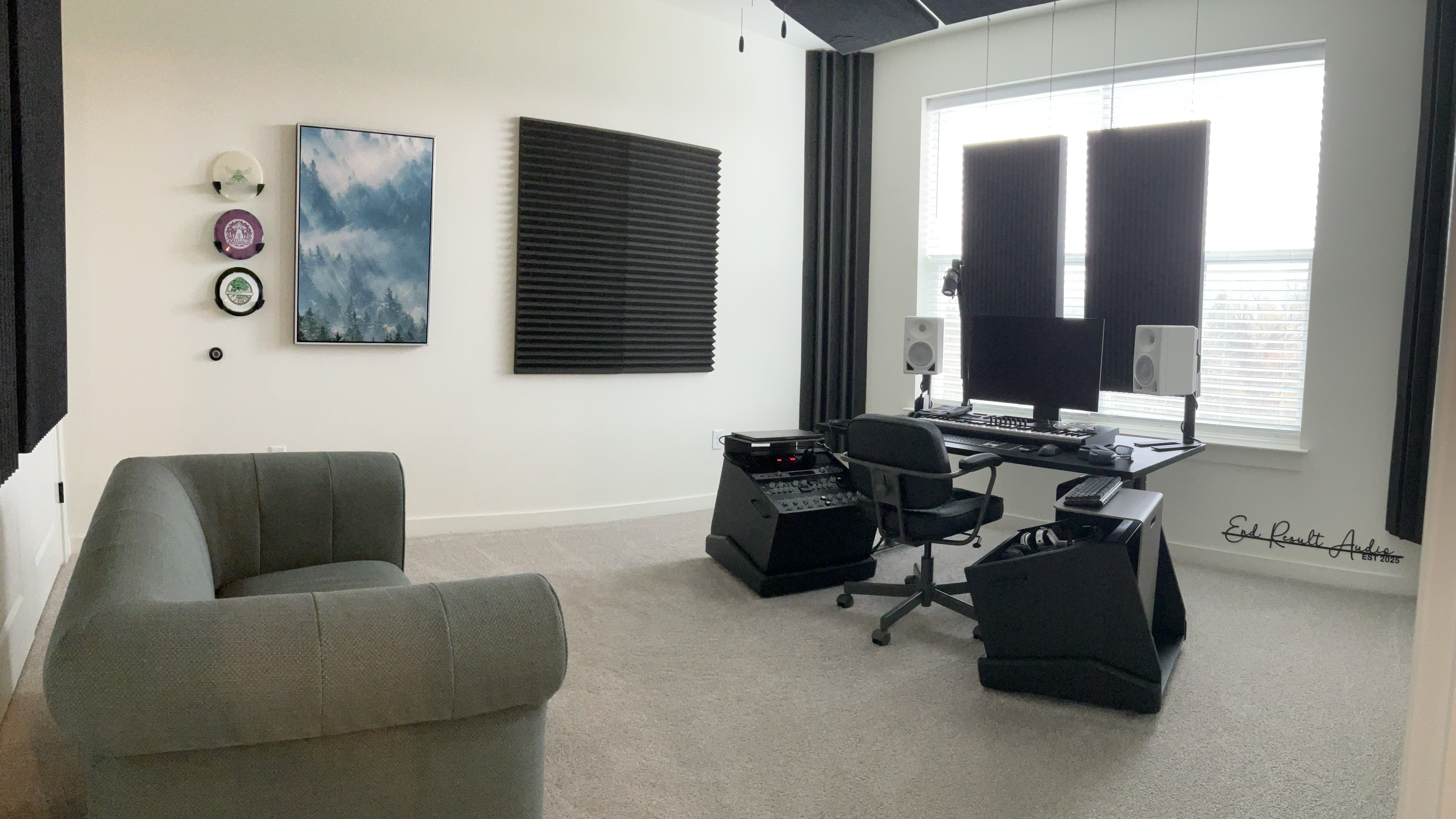
A repurposed space that houses more than just music. We can watch TV, play games, and I can still record vocals and play piano. The space remains treated and calibrated for sound as I have moved into a post production mindset where I can work on audio mastering for my music projects as well as for others. The space has been converted into something that brings joy instead of anxiety.
Without coping mechanisms such as walking lines, I wouldn’t have been able to get into this space and the above before and after pictures wouldn’t exist. Without removing the items that were causing compulsions, I wouldn’t have come to the realization of how much pressure I had been putting on myself in regards to music creation. Without that realization, I would have kept circling instead of redefining what I wanted from music and, therefore, from life. Can I enter the space and do whatever I want without risk of a contamination event now? Absolutely not. But I can enter the space and I have come to enjoy it rather than hate it. I started a blog and I’m typing this now. A win is a win.
Redefining normal means a couple of things. First, we shouldn’t hold others to our personal definition of normal behavior. We have no idea what others are experiencing. We need to understand that what’s “normal” for one person can be different for the next. This also means we need to have a sense of peace with our “normal” as we work through our issues understanding that what is normal today can be improved upon as we keep moving forward. Secondly, redefining normal can mean coming to realize we want something different from life than we thought we did. Sometimes we have to change our goals, our processes, or our spaces into something new. It’s ok to change your mind, give up an activity, and do something else with your time. This is true even if you’ve been doing said activity for 30 years. For me, music, the way I was doing it, went on for about 10 years too long and needed to be redefined. Don’t get stuck. Don’t let something that should be fun become something you hate. Especially don’t let it affect your mental health. Keep moving forward in life. Find a coping mechanism that gets you out of the place you’ve been trapped. Use that coping mechanism long enough to progress; leave it behind when it outlives its usefulness. Do this enough times and you’ll find yourself regaining functionality you thought you had lost.
Alright, this one got pretty long, but I’ll wrap up quick. For the next post in this series, I’m going to go further into mental bandwidth and, additionally, share my theory for what got me into this OCD mess in the first place.
Thanks for reading, Matt
If you’ve enjoyed this content, please consider commenting, liking, and subscribing. You can also follow on Instagram and Patreon.
 The Bean & Seed
Leave a comment